What Are the Three Ecological Groups? Autotrophs, Heterotrophs, and Decomposers
 Jul, 21 2026
Ecological Groups Interactive Explorer
Discover the three fundamental roles in any ecosystem: Producers, Consumers, and Decomposers. Click through to learn how energy flows and nutrients cycle through nature.
Producers
Autotrophs that create their own food from sunlight via photosynthesis.
Consumers
Heterotrophs that eat other organisms to obtain energy and nutrients.
Decomposers
Break down dead matter to return vital nutrients back to the soil.
Nature's Solar Panels
Autotrophs are the foundation of almost every food chain. They take inorganic materials like carbon dioxide and water, and use solar energy to turn them into sugar (glucose). Without producers, there would be no energy entering the biological system.
- Plants: Oak trees, wheat fields, and dandelions convert light into chemical energy.
- Algae: Phytoplankton produce over half of the oxygen we breathe.
- Cyanobacteria: Ancient microbes responsible for filling our atmosphere with oxygen.
The Energy Users
Heterotrophs cannot make their own food. They rely entirely on producers or other consumers for fuel. Ecologists break them down based on what they eat:
- Primary Consumers (Herbivores): Eat producers directly (e.g., deer, caterpillars).
- Secondary Consumers (Carnivores/Omnivores): Eat herbivores (e.g., foxes, spiders).
- Tertiary Consumers (Apex Predators): Top hunters with few natural enemies (e.g., sharks, wolves).
Note: Only about 10% of energy passes from one level to the next due to heat loss and metabolism.
The Recyclers
If producers start the party and consumers enjoy it, decomposers clean up the mess. They include bacteria, fungi, earthworms, and vultures. They chemically and physically break down dead tissue, releasing nitrogen, phosphorus, and potassium back into the soil so new plants can grow.
Without decomposers, Earth would be buried under mountains of dead bodies and waste, and ecosystems would collapse as nutrients become locked away.
Test Your Knowledge
Select the correct ecological group for each organism below.
Imagine walking into a forest. You see trees, you hear birds, and you might notice mushrooms growing on a fallen log. It looks like a random collection of plants and animals living side by side. But it isn't random. Every single living thing in that forest plays a specific role in how energy moves around. In ecology, we don't just look at what an organism is; we look at what it does. Specifically, we ask: where does it get its energy?
This question leads us to the three fundamental ecological groups: producers (autotrophs), consumers (heterotrophs), and decomposers (detritivores). These aren't just fancy labels for school textbooks. They are the engine parts of every ecosystem on Earth. If one group stops working, the whole system grinds to a halt. Understanding these groups helps you see why saving bees matters, why composting your kitchen scraps is powerful, and why cutting down forests affects air quality miles away.
The Producers: Nature's Solar Panels
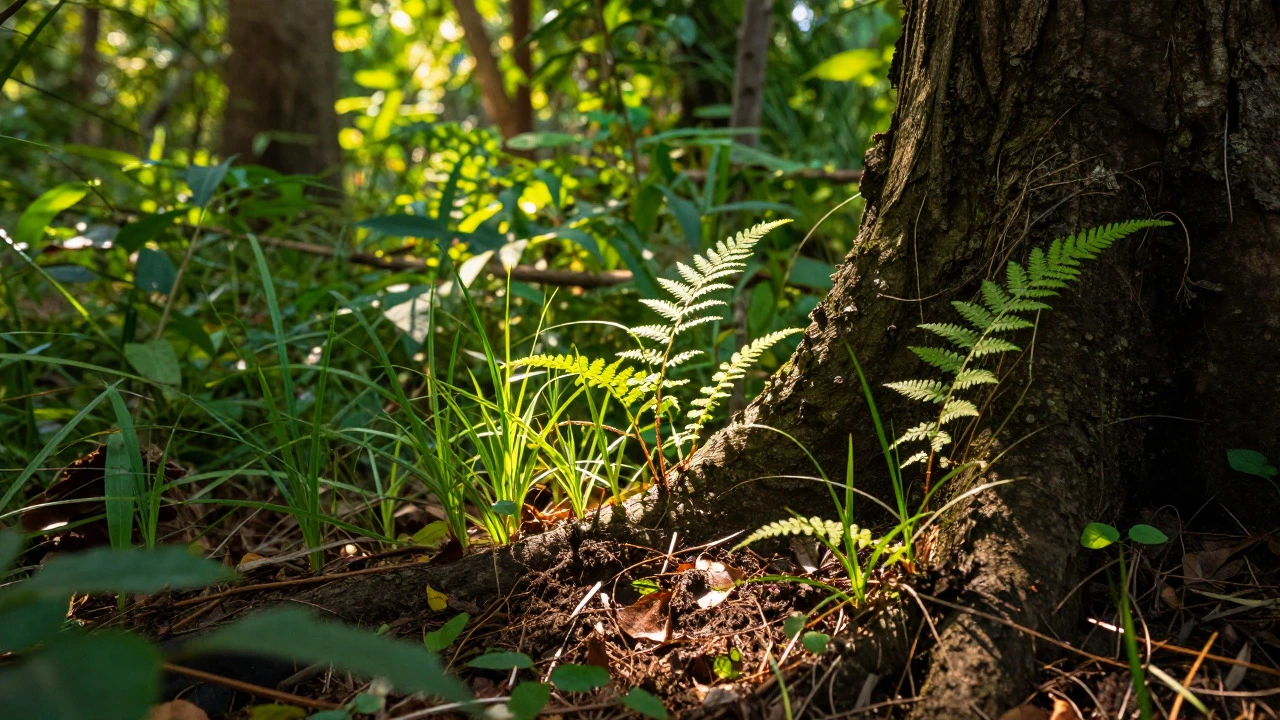
Think about your smartphone. It needs electricity to work. Now think about a tree. It needs sunlight. Trees, grasses, algae, and certain bacteria are called autotrophs because they make their own organic compounds. They take inorganic stuff-things like carbon dioxide from the air and minerals from the soil-and turn it into sugar using solar energy. This process is called photosynthesis.
Without producers, there would be no energy entering the biological system. Animals can't eat sunlight. We have to eat things that captured sunlight for us. That makes producers the primary source of biomass in an ecosystem. When you eat an apple, you are eating stored solar energy that the tree captured months ago.
- Plants: The most visible producers. Oak trees, wheat fields, and dandelions all convert light into chemical energy.
- Algae: Tiny producers in oceans and lakes. Phytoplankton alone produce over half of the oxygen we breathe.
- Cyanobacteria: Ancient microbes that were responsible for filling our atmosphere with oxygen billions of years ago.
If you remove the producers, the lights go out for everyone else. A forest without trees is just dirt. An ocean without phytoplankton is a dead zone. Their job is simple but critical: capture energy and store it in a form other organisms can use.
The Consumers: The Energy Users
Now let's talk about the rest of us. Humans, lions, eagles, cows, and even the fungi you see on bread are heterotrophs. We are consumers. We rely entirely on producers (or other consumers) for fuel. Since we can't do photosynthesis, we have to hunt, graze, or scavenge to survive.
Ecologists break down consumers into levels based on what they eat. This creates the structure of a food web.
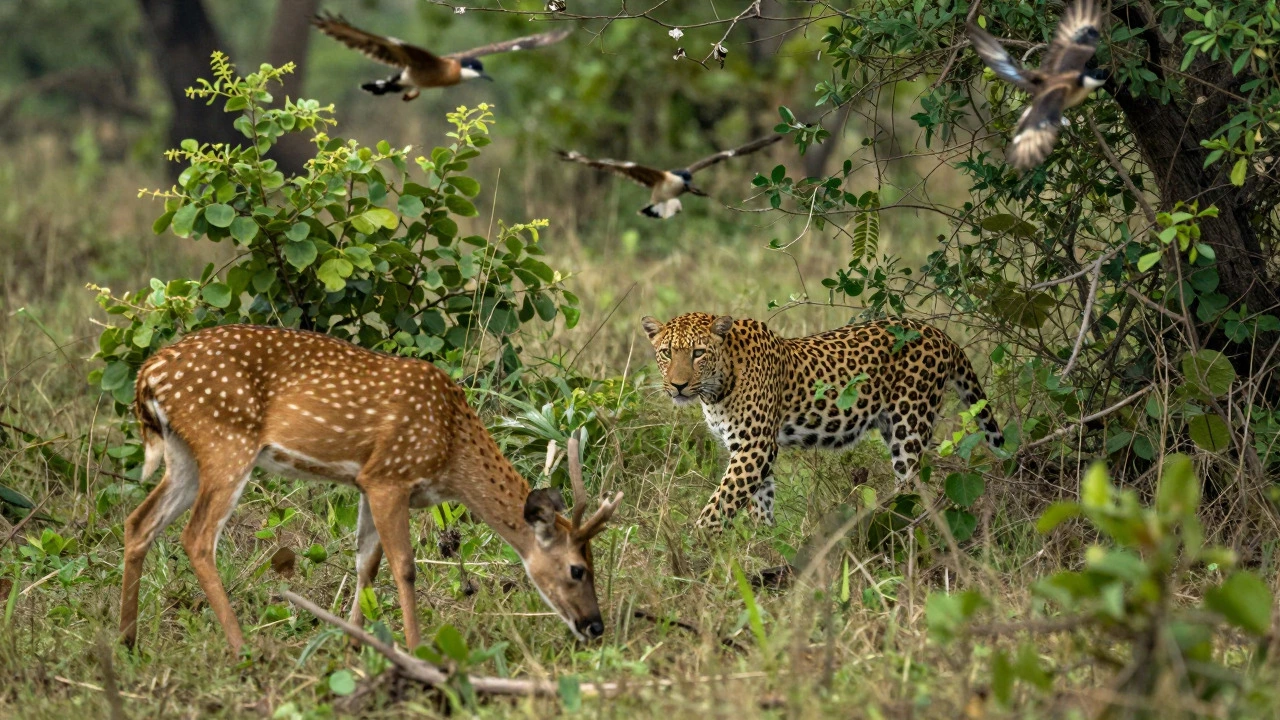
- Primary Consumers (Herbivores): These animals eat producers directly. A deer eating leaves, a caterpillar munching on a cabbage leaf, or a cow grazing in a field. They are the first link in the chain that transfers energy from plants to animals.
- Secondary Consumers (Carnivores/Omnivores): These eat the herbivores. A fox eating that rabbit, or a spider catching that caterpillar. They sit higher up in the energy pyramid.
- Tertiary Consumers (Apex Predators): These are the top hunters with few natural enemies. Think of sharks, wolves, or hawks. They keep populations of secondary consumers in check.
Here is a crucial point: energy transfer is inefficient. When a rabbit eats grass, it doesn't absorb 100% of the energy in that grass. Some is lost as heat, some is used for movement, and some is excreted. Generally, only about 10% of the energy passes from one level to the next. This is why there are millions of blades of grass, thousands of rabbits, but only a few foxes. As you go up the consumer ladder, there is less energy available, so fewer animals can be supported.
The Decomposers: The Recyclers
If producers start the party and consumers enjoy it, decomposers clean up the mess. Without them, Earth would be buried under mountains of dead bodies, fallen leaves, and waste. Within a few years, ecosystems would collapse because all the usable nitrogen, phosphorus, and potassium would be locked inside dead tissue instead of being available for new growth.
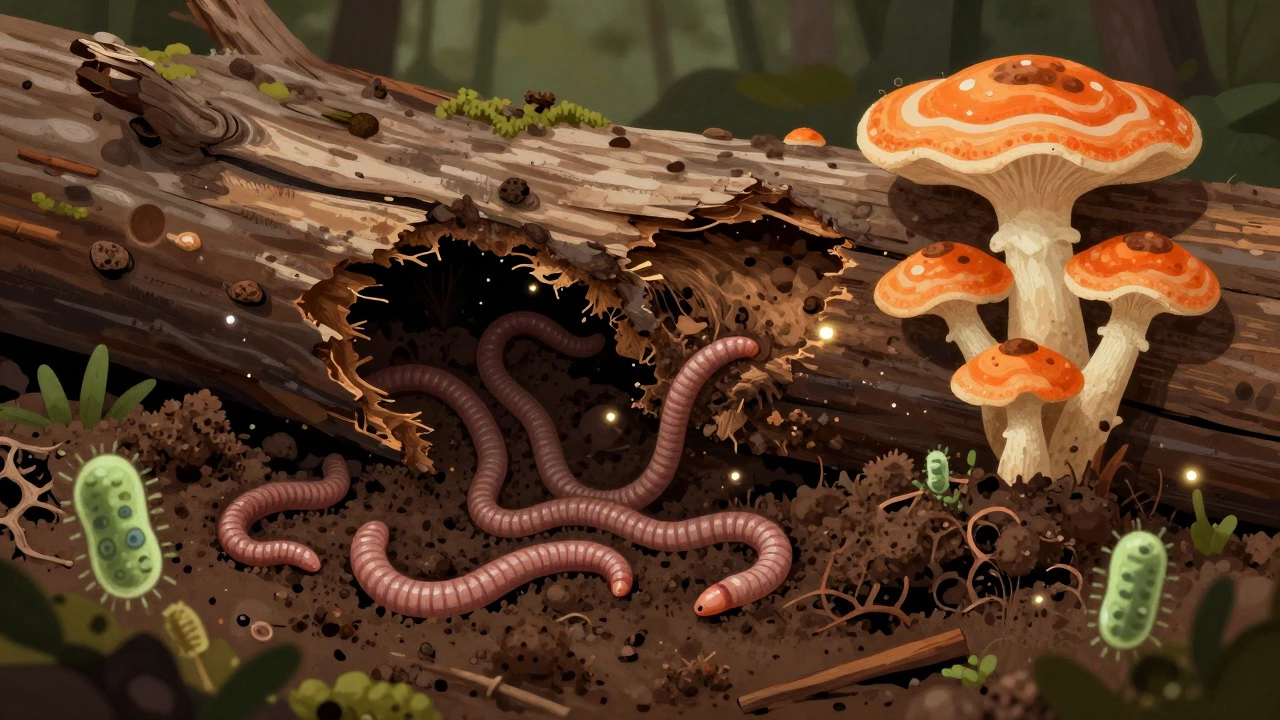
Decomposers include bacteria and fungi. Detritivores include earthworms, vultures, and dung beetles. While fungi and bacteria chemically break down material at a microscopic level, detritivores physically shred larger pieces of dead matter, making it easier for the microbes to finish the job.
Consider a fallen oak tree. It starts rotting. Fungi grow into the wood, breaking down tough lignin and cellulose. Earthworms tunnel through the decaying bark. Bacteria dissolve the remaining tissues. The result? Rich, dark humus in the soil. This humus feeds the roots of the next generation of oak trees. The decomposers close the loop. They turn death back into life.
How the Three Groups Interact
You can't really understand one group without seeing how it connects to the others. They form a continuous cycle known as the nutrient cycle. Let's trace a single atom of carbon through this system.
First, a plant (producer) takes carbon dioxide from the air and builds a leaf. Second, a caterpillar (primary consumer) eats the leaf, incorporating that carbon into its body. Third, a bird (secondary consumer) eats the caterpillar. Fourth, when the bird dies, fungi and bacteria (decomposers) break down its body, releasing carbon dioxide back into the air and nutrients back into the soil. The plant then uses that released carbon to grow again.
This interaction explains why biodiversity matters. If you lose a specific type of decomposer, certain types of waste might not break down efficiently. If you lose a key producer, the entire food web above it starves. If you remove a top predator, herbivore populations can explode and overgraze the producers, leading to soil erosion and desertification.
| Group | Scientific Term | Energy Source | Key Function | Examples |
|---|---|---|---|---|
| Producers | Autotrophs | Sunlight (Photosynthesis) | Create organic matter from inorganic sources | Trees, Grass, Algae |
| Consumers | Heterotrophs | Other Organisms | Transfer energy through the food web | Humans, Lions, Deer |
| Decomposers | Saprotrophs/Detritivores | Dead Organic Matter | Recycle nutrients back to the soil | Fungi, Bacteria, Worms |
Why This Matters for Human Impact
Understanding these three groups changes how we view environmental problems. Climate change, for instance, isn't just about hot weather. It's about disrupting the balance between these groups.
When we burn fossil fuels, we release ancient carbon that was stored for millions of years. This overwhelms the capacity of producers (plants and oceans) to absorb CO2. The excess heat stresses producers, causing coral bleaching in oceans and wildfires in forests. When forests burn, we lose producers. When corals die, marine food webs collapse.
Agriculture also plays a huge role. Modern farming often focuses heavily on producers (crops) and ignores decomposers. Heavy pesticide use kills beneficial insects and soil microbes. Tilling the soil disrupts fungal networks. Over time, the soil loses its ability to retain water and nutrients, forcing farmers to use more chemical fertilizers. This creates a dependency loop that harms the environment.
Regenerative agriculture tries to fix this by mimicking natural ecological groups. It covers soil with plants (producers), integrates livestock (consumers) to manage vegetation, and encourages healthy soil biology (decomposers) to build fertility naturally. By respecting the roles of all three groups, we can farm in a way that heals rather than depletes the land.
Common Misconceptions About Ecological Roles
People often confuse these categories. Here are a few clarifications to keep in mind.
Misconception 1: All fungi are decomposers. While many fungi are decomposers, some are parasites (acting like consumers) that feed on living hosts, such as rusts and mildews affecting crops. Others form symbiotic relationships with plant roots, trading nutrients for sugars.
Misconception 2: Humans are only consumers. Biologically, yes, we are heterotrophs. But culturally and economically, we act as managers of all three groups. We cultivate producers, domesticate consumers, and increasingly, we try to harness decomposers through composting and wastewater treatment. Our impact spans the entire web.
Misconception 3: Decomposers are "dirty" or "gross". This is a human bias. In nature, decomposition is a vital service. Vultures prevent the spread of disease by cleaning up carcasses. Earthworms aerate soil, allowing plants to grow. Without the "gross" stuff, the "pretty" stuff wouldn't exist.
Applying This Knowledge Locally
You don't need a degree in ecology to support these three groups. You can help maintain the balance in your own backyard or community.
- Support Producers: Plant native species. Native plants are adapted to your local climate and provide better food and shelter for local wildlife than exotic ornamental plants.
- Protect Consumers: Leave some weeds and brush. Many pollinators and birds need diverse habitats. Avoid broad-spectrum pesticides that kill beneficial insects along with pests.
- Encourage Decomposers: Start composting. Kitchen scraps and yard waste are perfect food for decomposers. Composting reduces landfill methane emissions and creates rich soil amendment for your garden.
By recognizing that every organism has a job, we start to value the entire system, not just the parts that are immediately useful or attractive to us. The forest works because the tree, the wolf, and the mushroom all play their part. We are part of that same system. How we treat these ecological groups determines whether the system thrives or collapses.
Are humans considered producers, consumers, or decomposers?
Humans are strictly consumers (heterotrophs). We cannot perform photosynthesis to make our own food, nor do we primarily break down dead organic matter like fungi or bacteria. We obtain energy by eating plants (primary consumption) or animals (secondary/tertiary consumption).
Can an organism belong to more than one ecological group?
Generally, an organism fits into one primary category based on its main energy source. However, some organisms are flexible. For example, some plants like the Venus flytrap are producers but also consume insects to get extra nutrients in poor soil. They are still classified as producers because they rely on photosynthesis for their primary energy needs.
Why are decomposers important if they don't produce food?
Decomposers are essential because they recycle nutrients. Without them, essential elements like nitrogen and phosphorus would remain locked in dead bodies and waste. Plants need these nutrients to grow. If decomposers stopped working, producers would eventually run out of raw materials, causing the entire food web to collapse.
What happens if there are too many consumers in an ecosystem?
If consumer populations grow too large, they can overconsume producers. This leads to habitat loss, soil erosion, and starvation for the consumers themselves. Natural predators usually keep consumer numbers in check. When humans remove apex predators, herbivore populations often explode, damaging the landscape.
Do all ecosystems have the same three groups?
Yes, virtually all terrestrial and aquatic ecosystems rely on producers, consumers, and decomposers. Even deep-sea hydrothermal vent ecosystems, which lack sunlight, have producers (chemosynthetic bacteria) that create energy from chemicals, consumers that eat those bacteria, and decomposers that break down waste.